Table of Contents
Reconcile payroll records in Reckon One
Learn how to reconcile your payroll records using the Payroll Summary report and the STP YTD report in Reckon One.
When to reconcile payroll
You will need to reconcile your payroll records as part of your annual end of financial year (EOFY) finalisation process, but it's also a good idea to reconcile your payroll records regularly throughout the year to avoid being surprised by errors at EOFY. Some businesses do this every pay cycle, while others do it quarterly or on some other regular basis.
Generate the reports
Open both reports in separate tabs so you can compare them side by side. Use This financial year as the reporting period on both.
- Open the Payroll Summary report. Click on Reporting and find Payroll Summary report under the Payroll category. In Show more options, set Include YTD to Yes so any initial YTD values appear in the totals.
- Open the STP YTD report in a new tab. Click on Reporting, then right-click Reports and select Open in a new tab (on Mac, hold ⌘ and click). Find STP YTD report under the Payroll category.
Understand what each report shows
There are a few key differences in the figures each report shows, and how they're displayed.
Payroll Summary report | STP YTD report | |
Scope | Shows all pay run figures, including pay items that are not reported via single touch payroll (STP) | Only figures reported to the ATO via single touch payroll (STP). The report excludes items that the ATO doesn't require:
|
Gross amounts | Aggregated (one combined figure). Earnings & leave is shown as one figure, made up of Gross Pay, Leave, Overtime, Bonus & Commissions, Directors Fees, Lump Sum and employment termination payments (ETP). | Disaggregated (a separate amount per payment type). Separate amounts are shown for Gross Pay, Leave, Overtime, Bonus & Commissions, Directors Fees, Lump Sum and employment termination payments (ETP). |
Pay run status | All pay runs | Pay runs with status of Paid or Done |
Fringe Benefits Tax (FBT) | Not included | Included |
Reconcile the reports
To reconcile the reports, you're comparing the values in the Payroll Summary report with the values on the STP YTD report.
The totals may vary dependent upon what type of pay item has been used throughout the pay run. For example, to reconcile earnings and leave amounts, you'll need to add the relevant disaggregated earnings & leave values in the STP YTD report (such as Gross Pay, Leave, Overtime, Bonus & Commissions, Directors Fees, Lump Sum and ETP). This should equal the Earnings & leave total in the Payroll Summary report.
Example
This example uses a book with 5 employees, each showing a different reason the two reports might differ.
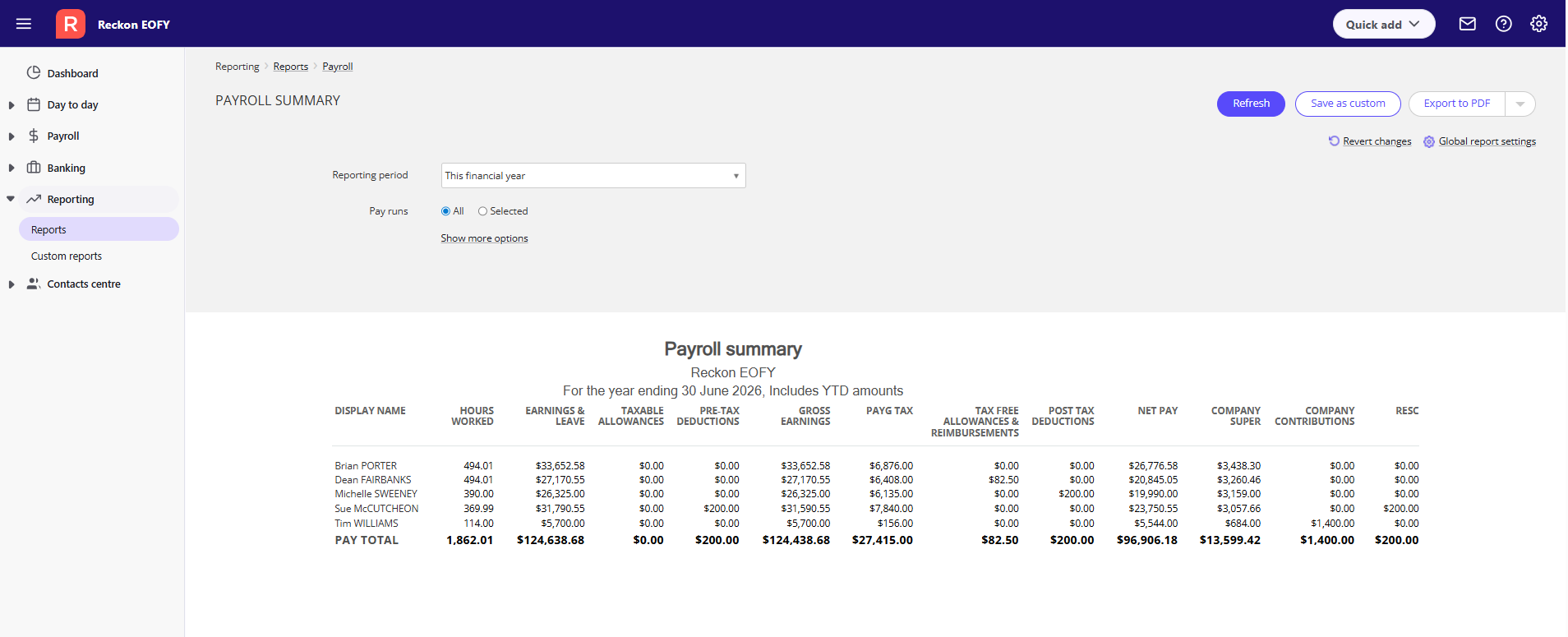
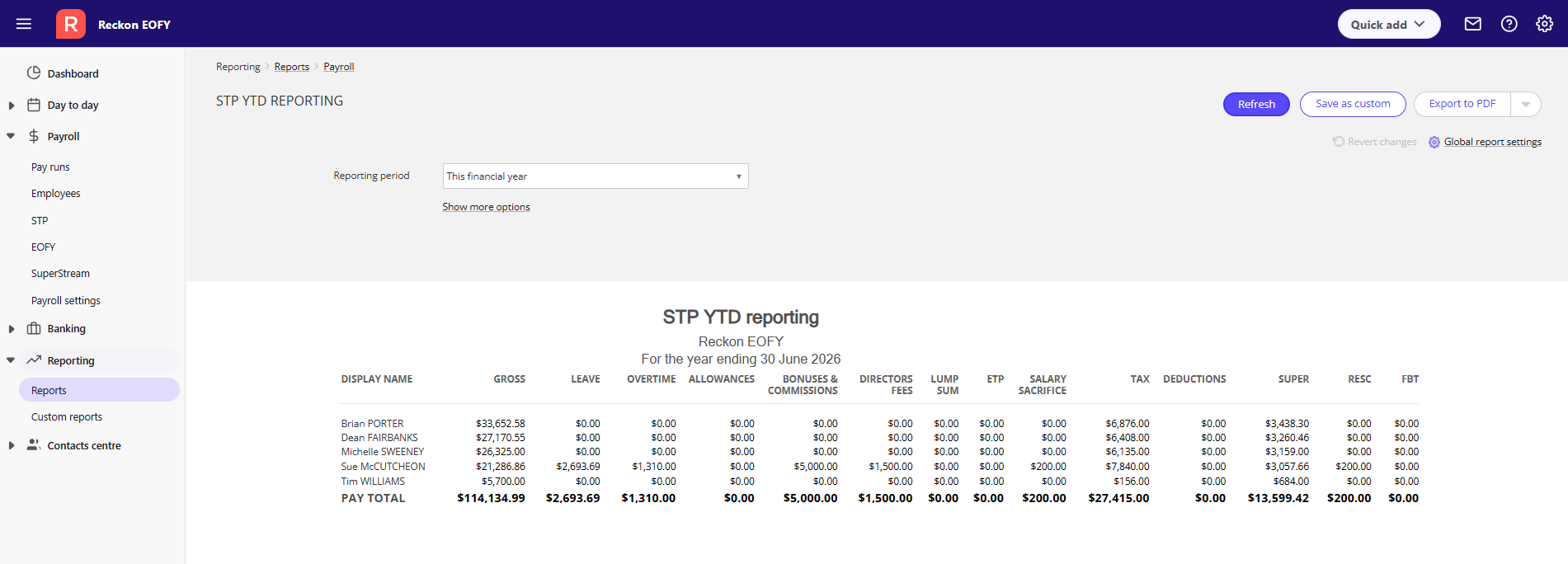
Employee | What they were paid | Payroll Summary | STP YTD | Why the difference? |
Tim WILLIAMS | Company contribution | ✅ Shows | ❌ Excluded | Post-tax — ATO doesn't require it |
Dean FAIRBANKS | Reimbursement | ✅ Shows | ❌ Excluded | Post-tax — ATO doesn't require it |
Michelle SWEENEY | Post-tax deduction | ✅ Shows | ❌ Excluded | Post-tax — ATO doesn't require it |
Sue McCUTCHEON | Overtime, Leave, Bonus, Directors Fees | Bundled total | Split across fields | Disaggregated in the STP YTD report for ATO purposes |
Brian PORTER | Initial YTD values | ✅ Shows (because the report is set to include YTD) | ✅ Shows | There is no difference across reports, because YTDs were included in the Payroll Summary report in this example. However, if you didn't set the Payroll Summary report to include YTDs, there would be a difference. |
Comparing the two reports, you'll see 4 differences:
- Gross earnings totals differ
- Reimbursements show on the Payroll Summary but not the STP YTD report
- Post-tax deductions show on the Payroll Summary but not the STP YTD report
- Company contributions show on the Payroll Summary but not the STP YTD report
To confirm whether these are expected, review the relevant employee(s). For additional information, refer to the Employee earnings summary report.
The variances fall into 2 categories - the items are post-tax items that don't need to reported to the ATO, or the earnings are disaggregated (split up).
Post-tax items the ATO doesn't need
Reimbursements, company contributions, and post-tax deductions all appear on the Payroll Summary report but are excluded from the STP YTD report, because the ATO doesn't require this data.
- Tim WILLIAMS was paid a company contribution - appears on Payroll Summary, not on STP YTD.
- Dean FAIRBANKS was paid a reimbursement - appears on Payroll Summary, not on STP YTD.
- Michelle SWEENEY had a post-tax deduction - appears on Payroll Summary, not on STP YTD.
In each case, the difference is expected, so you wouldn't need to take any action to resolve it.
Disaggregated gross earnings
Sue McCUTCHEON was paid Overtime, Leave, Bonus and Directors Fees during the year. On the Payroll Summary report these are bundled into Earnings & leave, but on the STP YTD report they're split into separate fields (as required by the ATO).
To reconcile Sue's totals, add Gross + Leave + Overtime + Bonus + Directors Fees from the STP YTD report - the sum should equal her Earnings & leave total on the Payroll Summary report.
There's also another potential variance that can occur with employees that have initial YTDs, but this isn't an issue in this example. If an employee has initial YTD values entered mid-year (like Brian PORTER in this example), they'll only appear on the Payroll Summary report if you set Include YTD to Yes in Show more options when generating the report. If you don't include YTD on the Payroll summary report, earnings figures for employees with initial YTDs will vary across reports.
Make corrections to STP data
If during the reconciliation process you notice inconsistencies that can't be explained by the differences in these reports, you'll need to make adjustments to correct STP reporting.
Read more
- Learn how to create and submit your EOFY finalisation after reconciling
Need more help?
Ask the Reckon Community at: https://community.reckon.com/categories/reckonone
Or log a Support Ticket: https://www.reckon.com/au/support/