Table of Contents
Create a custom super item in Reckon One
Learn how to create various superannuation pay type items in Reckon One, so the correct superannuation payments are calculated on your employees' earnings, allowances, and leave.
How superannuation payments work in Reckon One
In Reckon One, superannuation pay items represent different types of superannuation payments. These superannuation pay items are then included on specific earnings, allowances, deductions, and leave pay items, so that when you use those earnings, allowances, and leave pay items in a pay run, the correct super is calculated on them.
Your Reckon One book will already have several common super items set up, ready for you to use. You may like to edit these to suit your needs, or create new ones for specific purposes. The available superannuation types are:
- Super Guarantee
- Employer Additional
- Productivity
- Collective Agreement
- Salary Sacrifice
- Member Voluntary
- Spouse Deduction
Under Payday Super, super guarantee and super payments made under collective agreements are calculated from an employee's qualifying earnings (QE). Qualifying earnings includes payments from ordinary hours of work, and some other payments. In Reckon One, we don't automatically calculate superannuation based on whether a pay item is reported as QE. When you include superannuation pay items on your earnings, allowances, deductions, and leave items, we'll calculate super on those pay items whether they're reported as QE or not.
Create a new custom super item
- Go to Payroll, Payroll settings, then Pay Items.
- Select Create pay item, then select Superannuation from the list.
- Select the superannuation type you wish to create e.g. Super Guarantee, Employee Additional etc.
- Give the new super item a relevant and easily identifiable name and description.
- Select the expense account for the super item.
- Select the rate basis you want this item to calculate super on. You can select from the following options: Statutory Rate, Fixed Amount or Percentage of Earnings
- In Pay preferences, select the pay items that your new super item needs to calculate super on. Tick which earnings, allowances, deductions, and leave items that you would like the super item to be calculated on when used in a pay run.
You can also do this when editing or creating earnings, allowances, deductions, and leave pay items, by selecting the superannuation pay item under Superannuation preferences.
After you set up new super pay items, you need to assign them to the relevant employee super funds. Learn how to add or edit employee super fund details.
When super is calculated differently for different employees
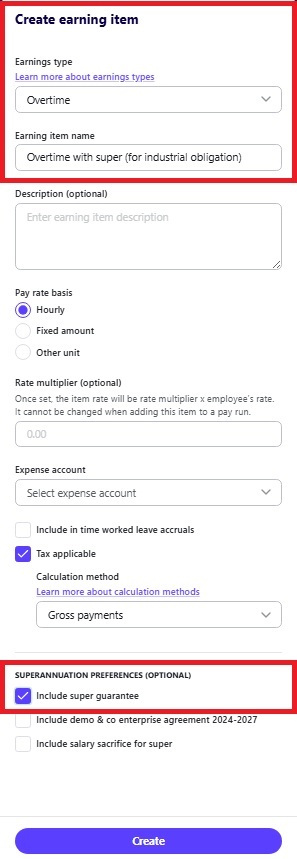
Depending on an employee's arrangements, some employees may need super calculated on certain earnings, allowances, deductions, and leave, and others may not. If this is the case, you'll need to set up different earnings. allowances, deductions or leave items for the different super calculation requirements. For example, if you have some employees who are under an industrial obligation that requires them to have super calculated on overtime, and other employees who are not under the industrial obligation (and therefore don't have super calculated on overtime), you'd need to:
- create 2 earnings pay items - one for employees who need super paid on overtime, and one for employees who don't
- in the relevant superannuation pay item, you'd tick to include only the earnings pay item that's created for employees who need super paid. Alternatively, in the earnings item for employees who need super paid, you'd tick to include super, and on the other earnings item, you wouldn't.
The example in the image below is of the earnings item that you would create for employees need super paid on overtime.
Read more
- Learn more about the different types of pay items in Reckon One
Need more help?
Ask the Reckon Community at: https://community.reckon.com/categories/reckonone
Or log a Support Ticket: https://www.reckon.com/au/support/