Table of Contents
Office Integration changes in Reckon Accounts Hosted
The following lists all the changes implemented from Reckon Accounts Hosted 2023 onwards, released to all Hosted users by 11 November 2023.
Spreadsheets/Workbooks
Export tips
Previously, Reckon Accounts had the option to “Include a new worksheet in the workbook that explains Excel worksheet linking”.
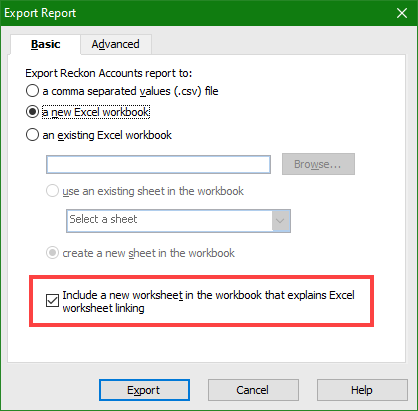
When exported, it adds a Reckon Accounts Export tips sheet that contains pointers. This is now available here instead regarding the Worksheets:
ABOUT | CUSTOMISE/UPDATE | TROUBLESHOOT |
| Setting up links between 2 or more worksheets to link up between Summary report and customised sheets
| Be aware that any difference in the structure of the current report from the report that you used when setting up links, can cause mismatch in the links between worksheets. If you are seeing wrong data in your customised worksheet, then you may have:
|
Auto Outline
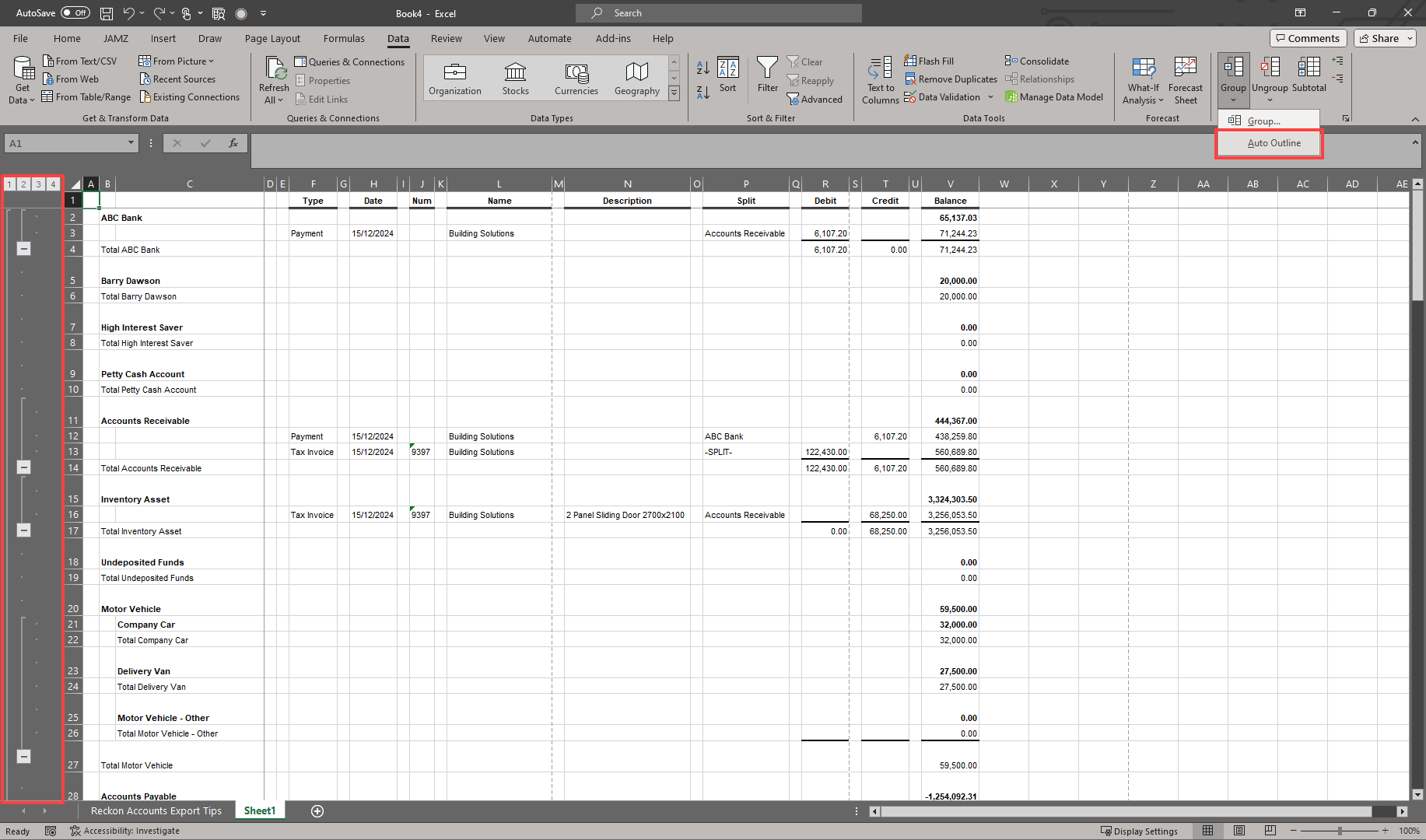
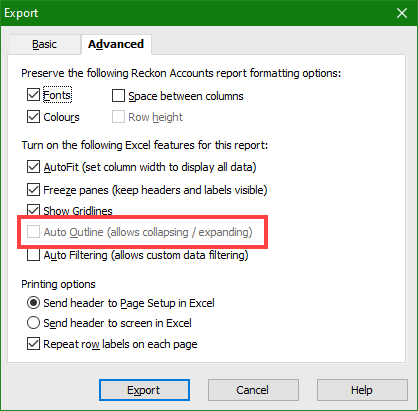
Previously, Reckon Accounts had the option to use “Auto Outline (allows collapsing / expanding)”. This is an Excel feature that groups the data based on depth-level.
The same option can be found in Microsoft Excel by going to Data > Outline > Group > Auto Outline.
Protected View
Export
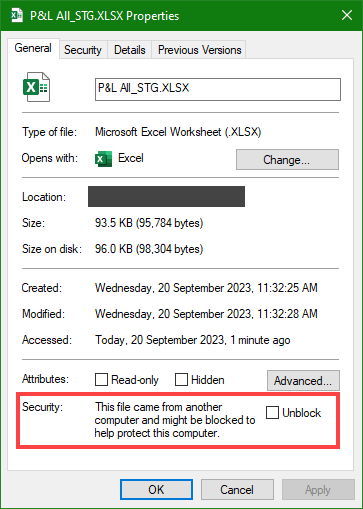
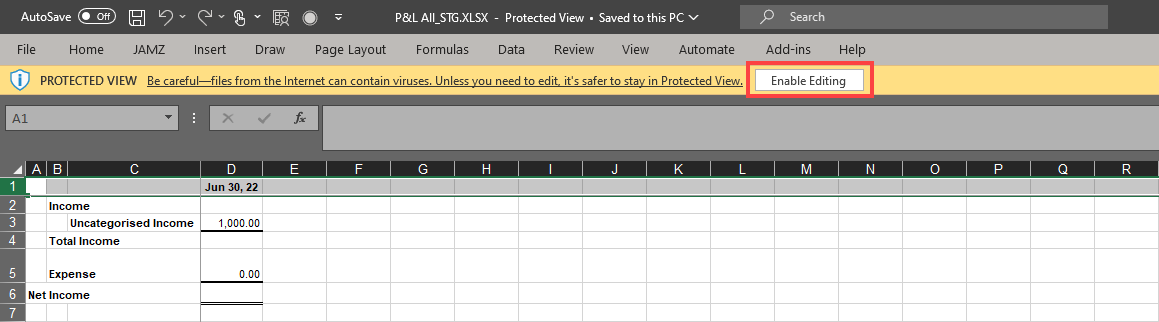
With the new spreadsheet integration, files downloaded from Reckon Accounts Hosted may automatically be protected. A Protected View is basically a read-only mode where most editing functions are disabled. This feature is to help protect your computer from files downloaded from the Internet.
Checking the Properties of the file will have the following additional Security attribute under the General tab.
The Unblock checkbox will disable the Protected View when selected.
When the file is opened and the Security is not changed, it will require the user to select the Enable Editing option so that:
- Users can modify the spreadsheet file
- For any formulas to perform the automatic calculations
- To use the local printer settings
Export to an existing sheet
You can import reports from Reckon Accounts Hosted to an existing spreadsheet from either an XLS or XLSX file type.
However, take note of the following:
CONDITION | BEHAVIOUR |
Standard XLS file type | Allowed Duplicates the spreadsheet to an XLSX file type. |
Standard XLSX file type | Allowed |
Protected Sheets without a Password | Allowed |
Protected Sheets with Password | Disallowed |
Protected Workbook without a Password | Disallowed |
Protected Workbook with a Password | Disallowed |
Importing
Country and ABN
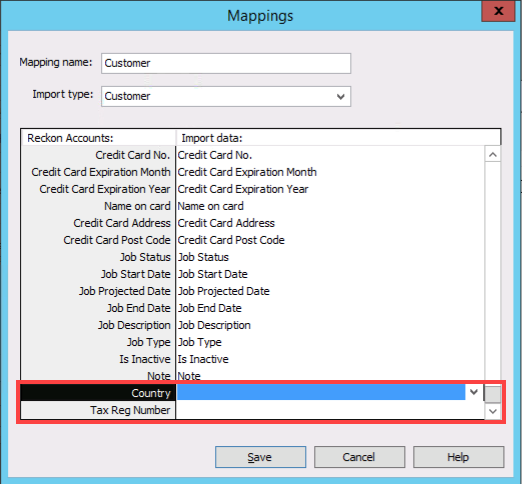
Two new fields are now available to support importing of Customer records with a business registration number.
- Country – to specify the country's name as seen from the Country dropdown.
- Tax Reg Number – to specify the business registration number of the entity.
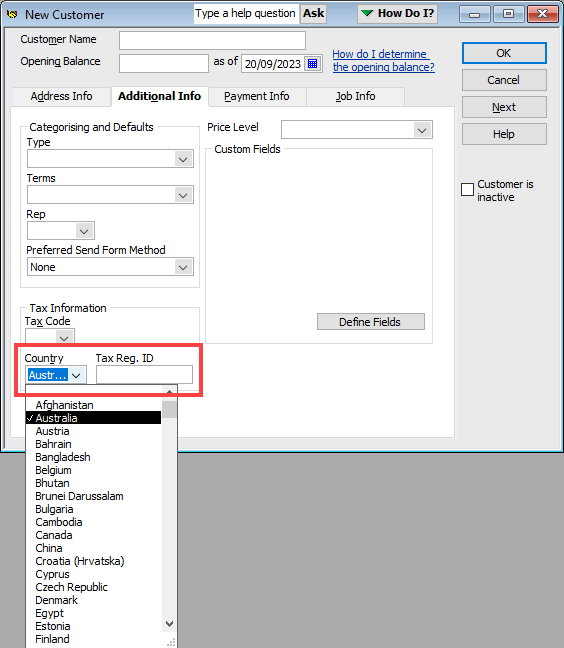
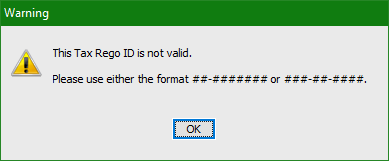
Previously, it uses the Resale Number field, but it defaults to the Country: USA. If the import file contains an ABN, it will fail to import, giving the following error:
In the new version, the addition of the two new fields will alleviate the above issue and ensures that the Customer record can be successfully imported with the correct data.
XLSX File Type
For any Lists or Reports that are to be exported using the Spreadsheet icon or Export button respectively, the Export window will be displayed on screen.
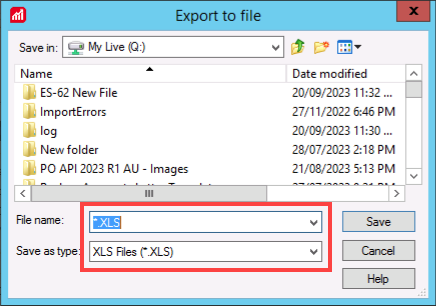
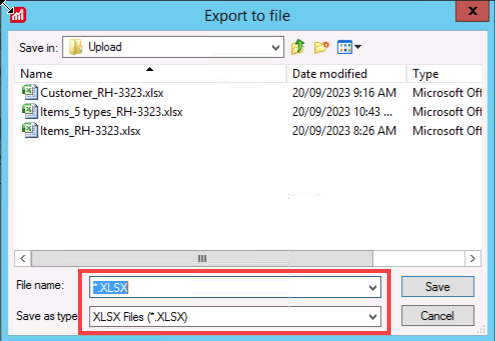
Clicking on the Export button will display the 'Export to file' window where the default File name and Save as type will now be *.XLSX and *.XLSX Files (*.XLSX) respectively.
 |
 |
Have a look at the format comparison table below:
XLS | XSLX | |
FORMAT | Excel 97 to Excel 2003 | Excel 2007 and later |
SIZE | Larger | Smaller This is relative to the report size. The bigger the report, the smaller the size. |
PERFORMANCE | Faster | Slightly slower |
COMPATIBILITY | Readable by any version | Only readable by Excel 2007 and later |
AVAILABILITY | Proprietary | Open |
RELIABILITY |
|
|
SECURITY | Executes embedded code (or macros) by default | More secure and transparent |
WORKSHEETS/CELLS | Supports up to 65,536 rows and 256 columns | Supports up to 1,048,576 rows and 16,384 columns |
Reckon Financial Statement Designer (RFSD)
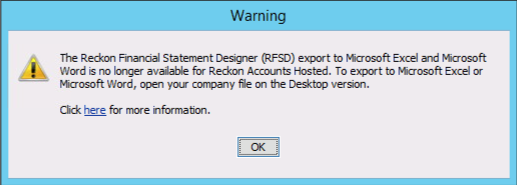
The ability to export to Microsoft Excel or Microsoft Word within Reckon Financial Statement Designer (RFSD) is no longer available.
When selecting the Reckon Financial Statement Designer option in Hosted, it will give the following dialogue that navigates to this topic.
If you use this feature, produce your report locally as a workaround by downloading your Company File and opening it from your Desktop version.

To use the Reckon Financial Statement Designer locally:
- Install the Reckon Accounts Enterprise in your Desktop with the same year version.Contact Customer Service or log in to Reckon Member's Site to obtain the download link and Installation Key Code (IKC).
- Create a backup of your Company File then download and save it locally.
- Restore the backup on your Reckon Accounts Desktop.
- Then, go to Reports > Reckon Financial Statement Designer and use it as per normal.
Document/Letters
File Type
Different document file format is now supported with the Office integration changes in Reckon Accounts Hosted.
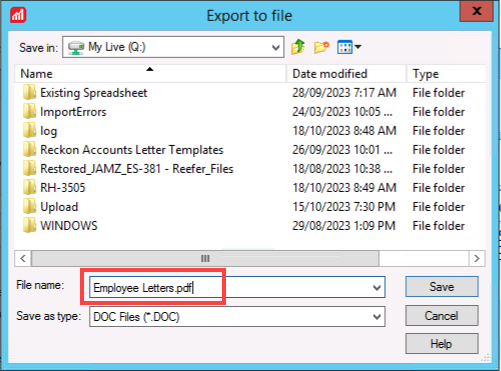
By default, letters generated from Hosted will be saved as a DOC file type.
However, you can change the file type of your document simply by appending the file type, for example, with .pdf. This will generate the document as a PDF file.
Supported Formats
FORMAT | DESCRIPTION |
DOC | Microsoft Word 97 – 2007 Document |
DOT | Microsoft Word 97 – 2007 Template |
DOCX | Office Open XML WordprocessingML Document (macro-free) |
RTF | RTF format |
ODF | ODF Text Document |
TXT | Plain Text |
Adobe Portable Document format |
Need more help?
Ask the Reckon Community at: https://community.reckon.com/categories/accountshosted
Or Log a Support Ticket: https://www.reckon.com/au/support/