Table of Contents
BankData - Fast Coding
Setting up BankData
For information on connecting BankData Fast Coding to your Reckon Hosted Data file, click here
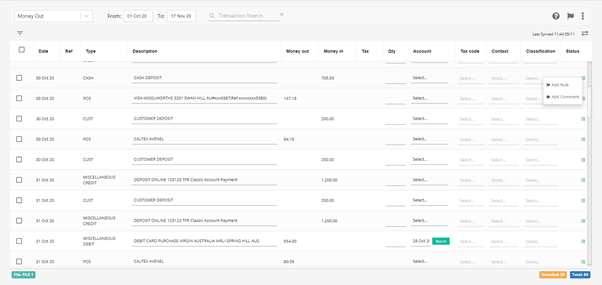
The Fast Coding Window
Fast Coding is a tool designed for working quickly with your Reckon Accounts Hosted bank account transactions. This is a particular requirement for accountants and bookkeepers who enter transactions on behalf of their clients, however anyone can use Fast Coding.
The data on the grid is designed to be navigated using the keyboard or the mouse. Editable fields can be typed into to display the relevant sections for the field, which can be selected via a dropdown menu.
Currently, when coding a transaction in Fast Coding it will create the following transactions in Reckon Hosted.
Money In | Money Out | |
Bank Account | Journal | Cheque |
Credit Card | Credit Card Credit/Refund | Credit Card Payment |
The functionality can be enabled via the Reckon Portal.
Click here for information on setting up Fast Coding for Hosted.
This will remove the coding from the Fast Coding window and also delete the transaction that was posted to Reckon Hosted.
Key Fields Explained
- Date Range – Transactions between these dates (inclusive) are displayed in the cash coding grid. Defaults to the beginning of the last calendar month through to the current date.
- Date – the transaction date according to the bank statement.
- Ref – the reference field, if provided by your bank.
- Type — - This displays the transaction type as provided by the Bank
- Description – the description field if provided by your bank.
- Money Out – payment of money (debit).
- Money In – receipt of money (credit).
- Tax – the GST content of the transaction. This is positive for a receipt and negative for a payment.
- Qty – the quantity associated with the transaction.
- Account – a combo box which allows you to search with your mouse (by using the dropdown list) or with your keyboard (by entering text and reviewing relevant account codes which match your search).
Simply press enter to select the highlighted account code. - Tax Code – Identical to the Account Code field above, but for selecting the GST Code.
- Contact – Ability to select a contact for the transaction. This is non-mandatory for Fast coding.
- Class — Ability to select a Class for the transaction.
- Status — Icons representing the various status' of transactions
 | Transaction has been coded |
 | Coded By Rule |
 | Launch the Actions Menu, to add a comment or a rule against the transaction |
 | Matched against an existing transaction in your linked file |
 | A comment has been added to the transaction, click the icon to view. |
Settings
The  icon can be used to access various settings or features, including:
- Display accounts by account code
- Select whether or not you track GST
- Enable Editable Descriptions, which allows you to edit the description that appears against the transaction
- Display Columns — Remove optional columns from the grid
- Upload transactions — Import transaction via a QIF
- Remove Transactions — This will only allow you to remove any transactions that were imported via a QIF. Any transactions imported via a Bank Feed are unable to be deleted.
- Back to Portal — Return back to the Reckon Portal
Other Key Functionality
Sync
To sync any changes that have been made to your Reckon Hosted Lists or Transactions, use the Sync Icon. 
You can continue to use the Online Banking Centre within Reckon Accounts Hosted if you prefer that method.
Splitting Transactions
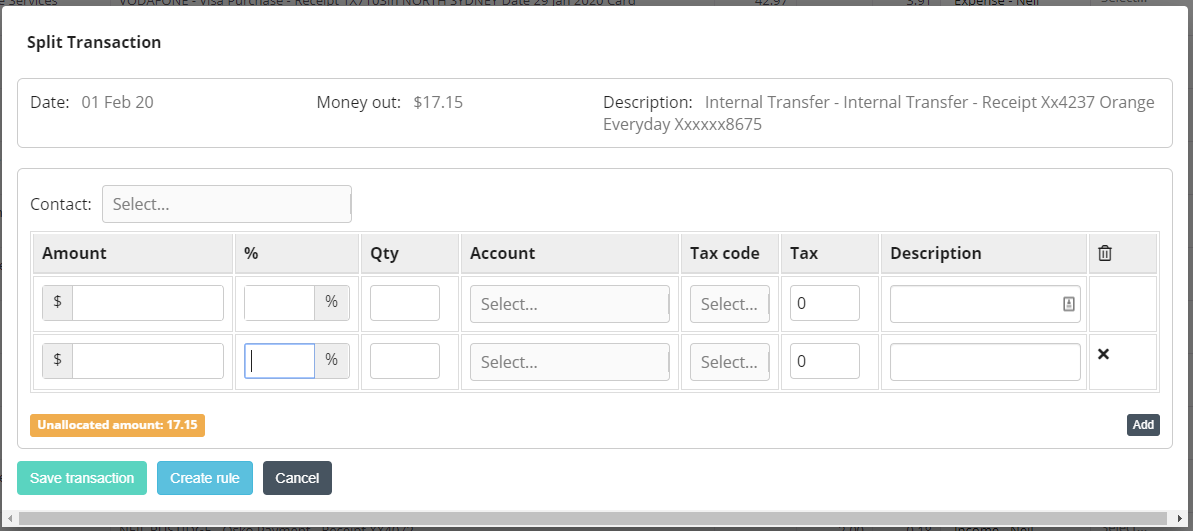
By selecting the top item on the Account dropdown list Split Transaction, a dialogue box appears showing the details of a transaction and enabling it to be split.
Classifications
If you have Classifications set up in your Reckon Accounts Hosted file, you will see a Classification field on the Fast Coding window as well as in the Split window. If you don't have any Classifications setup, these fields won't be visible.
Only Active Classifications are available to be able to be coded against a transaction.
Transaction Search
At the top of the Fast Coding window is a Transaction Search field. Using this field, you can filter the Fast Coding window to only display transactions that match the search criteria you enter. The Transaction Search works with the Date, Description, Money Out, Money In and Account fields.

The Search function will also search within Split Transactions and uses wildcards to enable you to find transactions where the description is a string of text (such as VISA-ReckonLTD-3201-SwanHill-AU)
You need to enter a minimum of three characters to perform a search.
Some Examples:
- Enter Reckon, only transactions that contain Reckon in the Description column will appear onscreen
- Enter 100.50, and only transactions with 100.50 in Money in or Money out (or description field) will appear onscreen
- Enter Consulting Income and only transactions coded to Consulting Income will appear onscreen
Batch Actions
Multiple Transactions can be selected using the  icon.
icon.
Depending on the status of the transactions selected, a list of Actions will be able to be performed
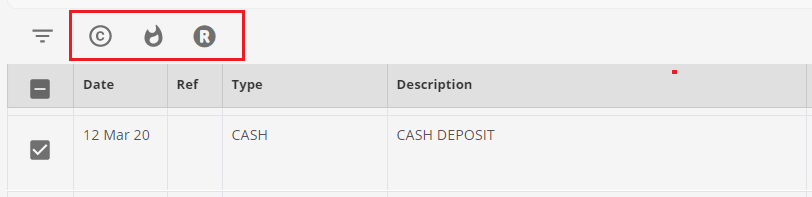
 | This allows you to quickly code a single split line transaction for all selected transactions. |
 | This allows you to automatically match against the most likely Reckon Hosted transaction. |
 | This allows you code multiple transactions using the Rule that has been applied to them. |
Shortcut Keys
/ | the Split Window will automatically open |
+ | Copy the coding from the previous transaction line. This shortcut will only work when the preceding transaction was the same type (e.g. Money In or Money Out) |
CTRL +M | Automatically open the Create Rule window for the selected transaction |
Eg: Do a Transaction Search for Caltex, to display all transactions for Woolworths, code the first transaction to the Fuel account. Hit '+' multiple times to quickly code each transaction for Caltex.
Filters
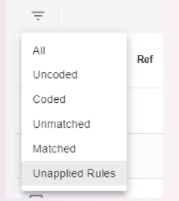
Click the Filter icon to filter the grid to only display Uncoded transactions, Coded transactions only, Unmatched transactions, Matched transactions (transactions that have a potential match to be accepted or declined) or transactions with Unapplied Rules.
Transaction Matching
In some cases, transactions that are imported via your BankFeed will have already been created in your Reckon Hosted data file. When this occurs, you can Match the Feed transaction against the Reckon Hosted transaction.
View the below Help File on Transaction Matching
Transaction Rules
Transaction rules can be set up to automatically code transactions that meet criteria that you have set in the Rule.
View the below Help File on creating and using rules.
Comments
Comments can be added to transactions, to add a comment, click the Action Icon.

Then select Add Comment, this will launch the Comments functionality where you can view or add a comment for the transaction.
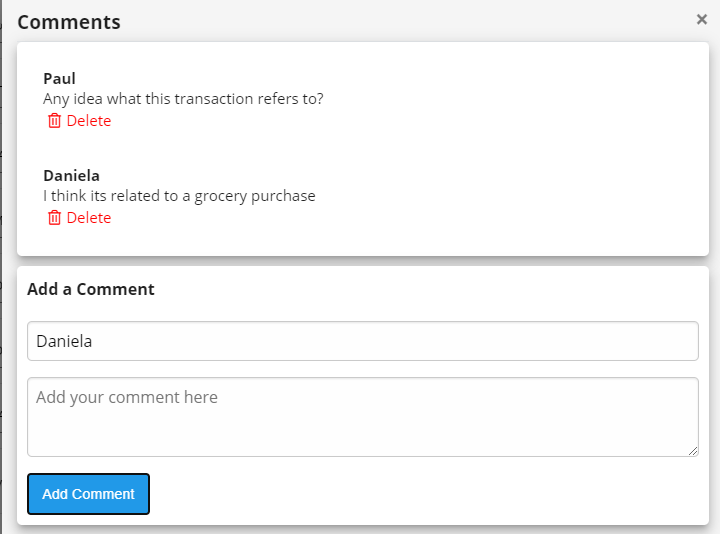
Any transaction that has had a comment added to it will have the below icon indicating how many comments have been assigned to the transaction.

Frequently Asked Questions
What happens if I change a transaction after coding it?
If a transaction is changed in Fast Coding, the updated transaction will replace the original transaction that was previously entered. If a transaction is created using the Fast Coding and then modified within Reckon Accounts Hosted, the change will be included the next time you Sync.
Any Date changes, or changes resulting in a different Total amount, won't be synced.
What happens if I code a transaction under the Reckon Hosted “Online Banking Centre”?
The coded transaction will appear as a match to be assigned to the Bank Feed transaction in Fast coding if it meets the criteria (Date & Amount).